
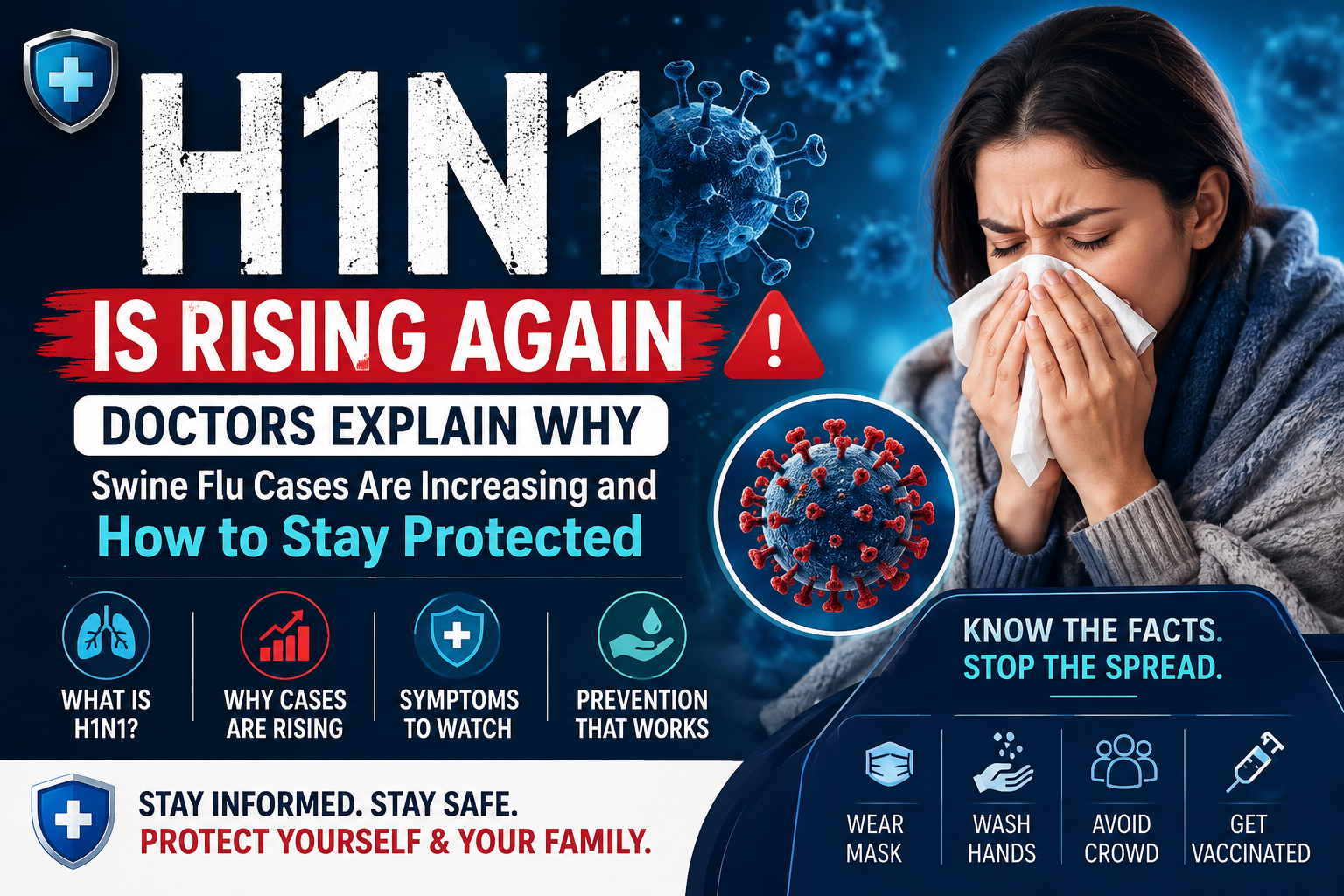
New Delhi, August 22, 2026: Cases of H1N1 influenza, commonly known as swine flu, are rising in Delhi and several other Indian cities, prompting doctors and health authorities to step up surveillance and preparedness. Delhi has recorded 1,777 H1N1 infections so far in 2026, as part of 2,392 reported Influenza-A cases, according to figures cited by the Delhi government on August 21.
Earlier National Centre for Disease Control (NCDC) data showed 1,449 H1N1 cases in Delhi up to August 12, compared with 229 during the corresponding period in 2025. The August 12 figure represented more than a six-fold increase over the same period last year.
The increase has been reported during the monsoon period, when influenza transmission can rise in India. Doctors, however, have cautioned that there is no single confirmed explanation for the current increase, and the precise reason for the rise would require further investigation.
H1N1 Cases Rising: What Is Behind the Increase?
H1N1 is a subtype of Influenza A. The virus that caused the 2009 H1N1 pandemic subsequently became established as a seasonal influenza virus rather than remaining a separate pandemic virus. The World Health Organization continues to classify seasonal influenza as a respiratory infection caused mainly by Influenza A and B viruses.
Doctors cited in recent reports have pointed to several factors that can contribute to increased influenza transmission during periods of higher activity.
One factor is seasonal and environmental conditions. An AIIMS New Delhi public-health expert told ThePrint that influenza transmission typically increases during the monsoon and again during winter, with humidity potentially playing a role. Increased gatherings and closer human contact can also facilitate transmission.
However, doctors have cautioned against attributing the current rise to a specific mutation without evidence. An internal medicine specialist quoted by The Indian Express said that the reason for the current increase would become clearer only after genetic investigation, while noting that increased person-to-person contact could also contribute.
Therefore, the current increase should not automatically be interpreted as evidence of a new H1N1 pandemic or a newly emerged virus.
Delhi Records Sharp Increase in H1N1 Cases
Delhi has been one of the areas reporting a significant rise.
According to NCDC data cited by The Indian Express, Delhi recorded 1,449 H1N1 cases by August 12, 2026, compared with 229 during the same period in 2025.
By August 21, the Delhi government reported 1,777 H1N1 infections and 2,392 Influenza-A cases for the year so far. The figures were discussed during a meeting chaired by Union Health Minister J.P. Nadda to review preparedness for seasonal influenza and vector-borne diseases.
The Delhi government said hospitals were being monitored and arrangements were being strengthened according to requirements. It also reported daily surveillance of influenza-like illness, severe acute respiratory infections and influenza cases through the Integrated Disease Surveillance Programme and the IDSP-IHIP platform.
H1N1 Symptoms: What to Watch For
H1N1 infection can produce symptoms similar to other forms of seasonal influenza. According to the World Health Organization, common influenza symptoms include:
- Sudden fever
- Cough, often dry
- Sore throat
- Headache
- Muscle and joint pain
- Fatigue or severe weakness
- Runny nose
Symptoms generally begin one to four days after infection, according to WHO. Most people recover within about a week, although cough and some other symptoms can last longer.
Because several respiratory infections can produce similar symptoms, symptoms alone cannot establish whether a person has H1N1. Medical assessment and testing may be required depending on the individual’s condition and clinical circumstances.
Who Is at Higher Risk of Severe Influenza?
Influenza can affect people of all ages, but some groups have a greater risk of serious complications.
WHO identifies the following groups as being at higher risk:
- Pregnant women
- Children younger than five years
- Adults aged 65 years and above
- People with chronic medical conditions
- People with suppressed immune systems
- Healthcare workers and others with increased exposure to influenza
Doctors in Delhi have also highlighted elderly people, young children and individuals with conditions such as diabetes, heart disease and lung disease as groups requiring particular attention.
Can H1N1 Become Severe?
Most influenza infections are not severe, but complications can occur.
WHO states that influenza can lead to pneumonia and sepsis in severe cases and can worsen existing chronic medical conditions. Recent reports from Delhi-NCR hospitals have also described some patients developing respiratory complications, including pneumonia and falling oxygen levels.
People experiencing difficulty breathing, chest pain, falling oxygen levels, severe weakness, confusion or worsening symptoms should seek prompt medical attention.
How Does H1N1 Spread?
Influenza spreads mainly through respiratory particles released when an infected person coughs, sneezes, talks or breathes. Transmission can also occur through contaminated hands.
The risk of transmission can increase in crowded or poorly ventilated indoor environments. WHO recommends improving ventilation and avoiding crowded, closed spaces when influenza activity is high.
How to Protect Yourself From H1N1
Several measures can reduce the risk of influenza infection and transmission.
Get Vaccinated
WHO identifies seasonal influenza vaccination as the best way to reduce the risk of influenza and severe disease. Because influenza viruses continually change and immunity decreases over time, seasonal vaccination is recommended annually for groups for whom vaccination is advised.
WHO particularly recommends annual influenza vaccination for high-risk groups such as pregnant women, young children, older adults, people with chronic illnesses and healthcare workers.
Improve Indoor Ventilation
Opening windows and improving air circulation can reduce exposure to respiratory particles. Avoiding crowded, poorly ventilated indoor spaces can also help reduce transmission.
Practise Respiratory Hygiene
People should cover their mouth and nose while coughing or sneezing, preferably using a tissue, and dispose of used tissues properly. Regular hand hygiene is also recommended.
Stay Home When Sick
People experiencing influenza symptoms should stay home as far as possible and avoid close contact with others. WHO also recommends mask use when symptomatic people have to enter crowded settings.
Avoid Self-Medication
Influenza is caused by a virus, so antibiotics do not treat the infection itself. WHO states that antiviral medicines can help reduce complications in people at higher risk of severe illness and work best when started early, ideally within 48 hours of symptom onset.
The choice to use an antiviral and the appropriate medicine should be determined by a healthcare professional.
Is H1N1 the Same as the 2009 Swine Flu?
The H1N1 virus became widely known during the 2009 influenza pandemic. WHO subsequently classified the pandemic virus as part of seasonal influenza circulation. Today, H1N1 refers to a seasonal Influenza-A subtype that continues to circulate alongside other influenza viruses.
Therefore, the current increase in H1N1 cases does not by itself mean that a new pandemic has begun.
H1N1 and Other Influenza Viruses
Influenza is not limited to H1N1. WHO states that seasonal influenza is primarily caused by Influenza A and B viruses. Different influenza viruses can circulate at the same time, and the dominant viruses can vary by location and season.
Recent reporting from Delhi has also identified Influenza-A infections beyond H1N1, while health authorities continue surveillance of influenza-like illness and severe respiratory infections.
What Doctors Are Advising
Doctors are urging people not to ignore persistent or worsening flu-like symptoms, particularly among vulnerable groups. At the same time, experts have stressed that not every case of fever, cough or breathlessness represents severe H1N1 infection.
The key measures remain early medical assessment when symptoms are concerning, vaccination for recommended groups, respiratory hygiene, hand hygiene, adequate ventilation and avoiding close contact with others while ill.
H1N1 Rise in India: Facts at a Glance
| Fact | Information |
|---|---|
| Virus | Influenza A(H1N1) |
| Common name | Swine flu |
| Current status | H1N1 is a seasonal influenza strain |
| Delhi H1N1 cases by Aug. 12, 2026 | 1,449 |
| Delhi H1N1 cases reported by Aug. 21, 2026 | 1,777 |
| Delhi Influenza-A cases reported by Aug. 21 | 2,392 |
| Delhi H1N1 cases in corresponding period of 2025 | 229 |
| Increase by Aug. 12 comparison | More than six-fold |
| Major transmission route | Respiratory particles and contaminated hands |
| Common symptoms | Fever, cough, sore throat, headache, body aches, fatigue, runny nose |
| Higher-risk groups | Young children, older adults, pregnant women, people with chronic illnesses and immunocompromised people |
| Best prevention measure | Seasonal influenza vaccination |
| Other preventive measures | Hand hygiene, respiratory hygiene, ventilation, avoiding crowded closed spaces and staying home when sick |
| Antibiotics | Do not treat influenza viruses |
| Antivirals | Can be used for appropriate patients, particularly those at higher risk; work best when started early |
| Current rise and pandemic | The rise in seasonal H1N1 cases does not by itself indicate a new pandemic |
H1N1 Cases in India: Key Takeaway
The recent increase in H1N1 cases in Delhi and reports of rising influenza activity in other Indian cities have put seasonal influenza back in the spotlight. Current evidence does not establish one single reason for the increase; seasonal conditions, increased contact between people and other factors may contribute, while the exact cause of a particular rise requires epidemiological and virological assessment.
For the public, health authorities and WHO continue to emphasise established influenza-control measures: vaccination for recommended groups, good respiratory and hand hygiene, ventilation, avoiding crowded closed spaces and timely medical care when symptoms become severe or occur in high-risk individuals.
Sources and Fact Verification
This article has been independently researched using WHO, WHO India, the National Centre for Disease Control (NCDC), Delhi government information reported through PTI, and current reporting from The Indian Express, NDTV and ThePrint. The NCDC’s official website lists dedicated information on seasonal influenza (H1N1), including the 2026 influenza-vaccine composition and historical state/UT case and death data.