

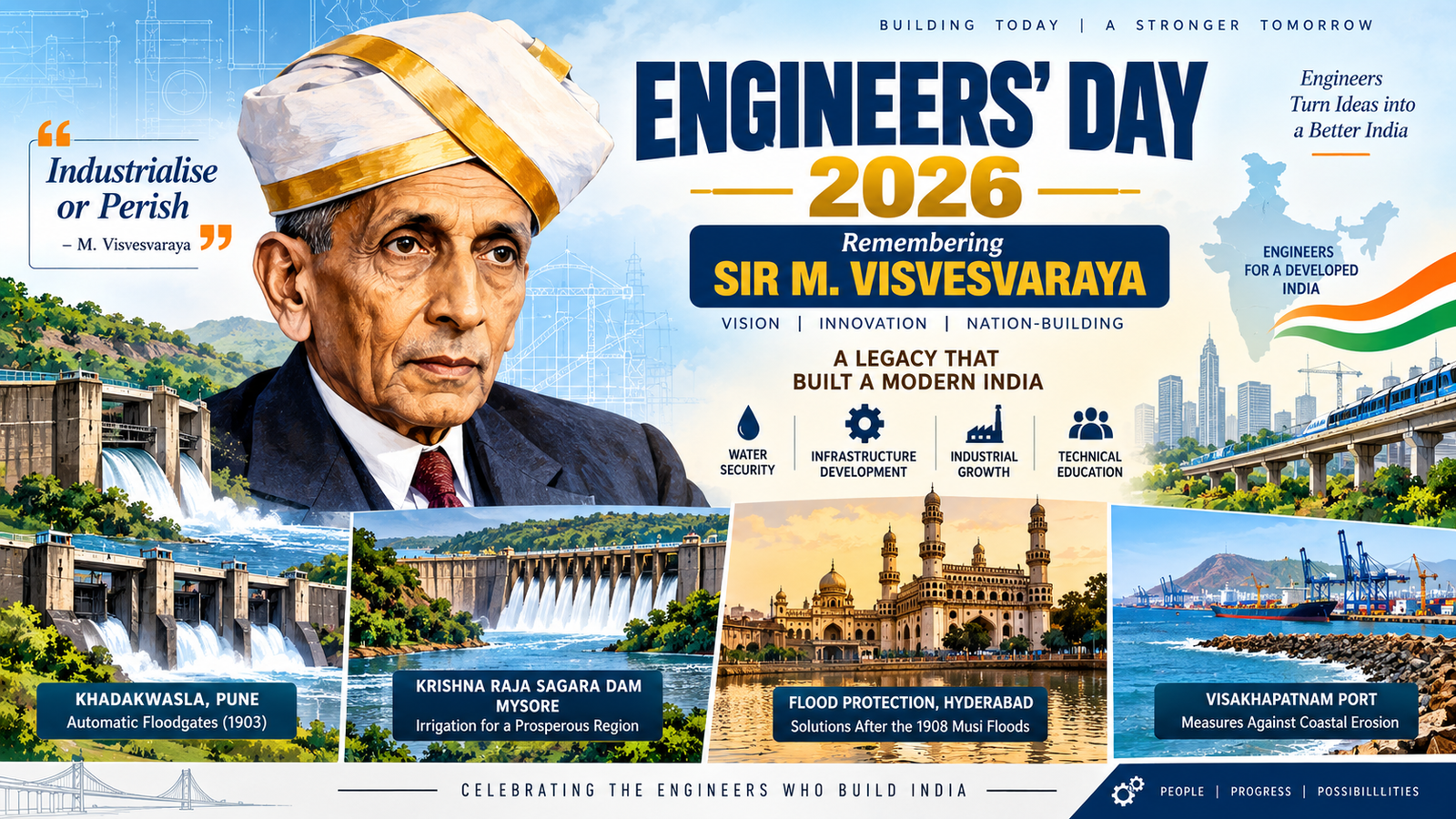
Engineers’ Day 2026 is being observed across India on September 15, but the date is much more than an annual occasion to congratulate engineers.
It marks the birth anniversary of Sir Mokshagundam Visvesvaraya, the legendary civil engineer, administrator and nation-builder whose work in water management, irrigation, flood control and industrial development left a lasting imprint on modern India.
From the automatic floodgates at Khadakvasla near Pune to the Krishna Raja Sagara (KRS) Dam in Mysore, and from flood-protection planning after the devastating 1908 Musi floods in Hyderabad to work associated with protecting Visakhapatnam Port from erosion, Visvesvaraya repeatedly approached engineering as a solution to real public problems.
That is what makes his story particularly relevant in 2026.
At a time when India is dealing with urban flooding, water security, climate resilience, rapid infrastructure expansion and technological transformation, the central idea behind Visvesvaraya’s career still feels remarkably modern:
Engineering is not simply about building structures. It is about solving problems that affect society.
When is Engineers’ Day 2026?
Engineers’ Day 2026 is being observed on Tuesday, September 15.
India observes Engineers’ Day every year on September 15 to commemorate the birth anniversary of Sir M. Visvesvaraya.
The date is officially recognised as a tribute to his contribution to engineering and nation-building. In 2026, the occasion also coincides with the 24th Convocation of Visvesvaraya National Institute of Technology (VNIT), Nagpur, scheduled for September 15.
But why was Visvesvaraya chosen as the figure whose birthday would represent India’s engineering community?
The answer lies in the extraordinary range of problems he tackled during his long career.
Who was Sir M. Visvesvaraya?
Sir Mokshagundam Visvesvaraya (1861–1962) was one of India’s pioneering civil engineers and administrators.
He began his professional career as an engineer in the Bombay Presidency and gradually developed a reputation for solving difficult problems involving water supply, irrigation, reservoirs, drainage and flood control.
His career eventually took him to Mysore, where he served as Chief Engineer and later as the Diwan of Mysore from 1912 to 1918.
He was not simply a technical expert working on individual projects. He was deeply interested in industrialisation, education, public administration and economic development.
The Government of India awarded him the Bharat Ratna in 1955, recognising his distinguished contribution to engineering and nation-building.
That combination of engineering expertise and public leadership is central to understanding why his name became synonymous with India’s engineering tradition.
Why is September 15 celebrated as Engineers’ Day?
September 15 is the birth anniversary of M. Visvesvaraya.
India uses the occasion to recognise not only his achievements but also the contribution of engineers to infrastructure, industry, science, technology and economic development.
Government sources describe Visvesvaraya as an important figure in the development of India’s modern engineering landscape. Engineers’ Day therefore serves two purposes: it remembers an extraordinary engineer from India’s past and recognises the engineers working on the country’s present and future challenges.
The occasion has now become an important date for engineering colleges, professional institutions, government departments and technical organisations.
But the most interesting way to understand Engineers’ Day is to look at the problems Visvesvaraya was actually trying to solve.
From Pune to Mysore: How Visvesvaraya Changed Water Engineering
Water was at the heart of much of Visvesvaraya’s engineering career.
At a time when modern hydraulic modelling, computer simulations and satellite-based monitoring did not exist, engineers had to depend heavily on physical measurements, field observations, mathematical calculations and practical experimentation.
Visvesvaraya became known for combining those tools with an unusually strong instinct for innovation.
What did Visvesvaraya do at Khadakvasla near Pune?
One of his best-known engineering innovations was associated with Khadakvasla Reservoir near Pune.
The challenge was straightforward but technically difficult: how could the storage capacity of a reservoir be increased without simply raising the height of the dam?
Visvesvaraya developed and patented an automatic system of weir water-floodgates.
The system was first installed at Khadakvasla in 1903.
The innovation allowed water levels to be regulated more efficiently and helped increase usable storage while protecting the dam. Its success subsequently led to the technology being used at other locations.
It is an excellent example of the kind of engineering that defined Visvesvaraya’s career: instead of accepting an existing limitation, he looked for a way to improve the performance of the system itself.
Visvesvaraya and the 1908 Hyderabad floods
Perhaps the most dramatic example of his engineering work came after the Musi River floods of 1908.
The disaster devastated Hyderabad.
The Central Water Commission’s historical account records the extraordinary scale of the flooding. Water levels in the city rose dramatically, thousands of people died and tens of thousands were left homeless. The Nizam’s government wanted a permanent solution rather than temporary repairs.
The government sought Visvesvaraya’s expertise.
He arrived in Hyderabad in 1909 and studied rainfall, flood behaviour and the city’s drainage problems.
His assignment was not limited to designing a dam. He was asked to advise on:
- reconstruction of Hyderabad;
- long-term flood protection;
- drainage planning; and
- measures to prevent another catastrophe.
His central proposal was to create upstream reservoirs capable of holding back floodwaters before they reached Hyderabad.
The subsequent development of Osman Sagar and Himayat Sagar became an important part of Hyderabad’s flood-management and water-supply history.
This episode offers an important lesson even for today’s urban planners.
Visvesvaraya was not merely trying to control a river after a flood had occurred. He was attempting to change the system so that the city would be less vulnerable to the next flood.
That is essentially what modern disaster-resilient infrastructure seeks to achieve.
The Krishna Raja Sagara Dam: Visvesvaraya’s Most Famous Project
If one project is almost inseparable from Visvesvaraya’s name, it is the Krishna Raja Sagara Dam, commonly known as KRS.
Built across the Cauvery River in Karnataka, the project became central to irrigation and water management in the Mysore region.
Government sources credit Visvesvaraya with planning and implementing the project, while technical and historical accounts highlight the scale of the engineering challenge involved.
The significance of KRS went beyond the dam itself.
Water storage meant irrigation.
Irrigation meant greater agricultural productivity.
Reliable water supplies supported settlements and economic activity.
And the project demonstrated how engineering infrastructure could become a foundation for regional development.
That is why Visvesvaraya’s legacy is often discussed in terms of nation-building rather than simply dam construction.
What made KRS an engineering challenge?
The project was undertaken during a period when large-scale dam construction in India was still developing.
One particularly interesting aspect of the KRS story is the engineering approach used during construction.
Government science-and-technology material highlights Visvesvaraya’s work on KRS and notes the unusual construction techniques used during the period, including the challenge of building the large masonry dam when cement production was still in its early stages in India.
The project therefore became an important demonstration of engineering ingenuity under difficult technological and material constraints.
What was Visvesvaraya’s role in Visakhapatnam?
Visvesvaraya’s engineering work also extended beyond inland water management.
Government sources credit him with working on measures to protect Visakhapatnam Port from erosion.
This part of his career is sometimes overshadowed by KRS and Hyderabad, but it reveals something important about his expertise.
His professional work was not restricted to one type of structure.
He worked on problems involving:
reservoirs → irrigation → flood control → drainage → water supply → coastal and port infrastructure
That breadth is one reason his engineering legacy remains significant.
Visvesvaraya was more than a civil engineer
It would be easy to remember Visvesvaraya simply as the engineer behind dams and flood-control systems.
That would, however, leave out half of his story.
His years in Mysore demonstrated his interest in industrialisation, education, finance and institutional development.
As Diwan of Mysore between 1912 and 1918, he was associated with the development of several important institutions and industrial projects, including the Mysore Soap Factory, the Iron and Steel plant at Bhadravati and the State Bank of Mysore.
He also promoted technical and industrial development because he believed that engineering capability had to be connected to economic progress.
This explains why Visvesvaraya is remembered as both an engineer and a statesman.
Why is Visvesvaraya called the “Father of Modern Mysore”?
The title reflects the scale of his contribution to Mysore’s institutional and industrial development.
He believed that infrastructure alone could not transform a society.
A modern economy required:
- technical education;
- industries;
- financial institutions;
- better infrastructure;
- efficient administration; and
- skilled human resources.
His years as Diwan therefore became an important phase in Mysore’s modernisation.
His approach was strikingly developmental for its time: build the physical infrastructure, develop institutions and train people capable of sustaining that development.
“Industrialise or Perish”: The idea behind Visvesvaraya’s vision
Visvesvaraya’s famous phrase “Industrialise or Perish” captures his belief that India needed industrial and technological capacity to achieve economic progress.
His thinking extended beyond engineering projects.
He wrote about economic planning, industrialisation and India’s development prospects. Among his notable books were Reconstructing India and Planned Economy for India. His memoir, Memoirs of My Working Life, documented his professional journey.
This makes his legacy particularly interesting for students of Indian economic history.
Long before independence, he was asking questions that India would continue to debate for decades:
How should India industrialise?
How can technical education support economic development?
How can infrastructure improve productivity?
How can limited natural resources such as water be used more efficiently?
Those questions remain relevant even today.
Why Visvesvaraya’s ideas still matter in 2026
India in 2026 is very different from the India in which Visvesvaraya worked.
Today’s engineers have access to satellite imagery, artificial intelligence, computer-aided design, advanced materials, digital twins, sensors and sophisticated climate models.
Yet many of the underlying challenges have not disappeared.
Cities still face flooding.
Farmers still depend on reliable irrigation.
Water security remains a major development issue.
Infrastructure has to withstand increasingly complex environmental risks.
Ports and coastal cities face erosion and extreme weather.
And India’s economic ambitions continue to depend on engineering, manufacturing, energy and technological capability.
This is where Visvesvaraya’s legacy becomes more than historical trivia.
His central approach was to understand the problem, improve the system and design for the future.
That is precisely the mindset modern infrastructure planning demands.
Engineers’ Day 2026: From dams to AI and semiconductors
The meaning of engineering has changed dramatically since Visvesvaraya’s time.
Today’s Indian engineers are working in fields ranging from:
artificial intelligence and robotics to semiconductors, renewable energy, aerospace, biotechnology, cybersecurity and advanced manufacturing.
The engineering profession is therefore no longer limited to bridges, dams and machines.
Yet the fundamental purpose remains similar.
A good engineer takes a complex problem and turns scientific knowledge into something that works in the real world.
That is why Engineers’ Day continues to resonate beyond engineering colleges.
It is ultimately a celebration of problem-solving.
M. Visvesvaraya: Important facts for competitive exams
For UPSC, SSC, Banking, Railway and State PCS aspirants, the following facts are worth remembering:
| Fact | Details |
|---|---|
| Full name | Sir Mokshagundam Visvesvaraya |
| Born | September 15, 1861 |
| Died | 1962 |
| Profession | Civil Engineer, administrator and statesman |
| Engineers’ Day | September 15 |
| Bharat Ratna | 1955 |
| Major project | Krishna Raja Sagara Dam |
| Pune connection | Automatic floodgates at Khadakvasla, 1903 |
| Hyderabad connection | Flood-protection planning after 1908 Musi floods |
| Visakhapatnam connection | Work associated with protection of the port from erosion |
| Diwan of Mysore | 1912–1918 |
| Famous phrase | “Industrialise or Perish” |
These facts are especially useful because questions on important personalities, national days, dams, engineering achievements and Bharat Ratna awardees frequently overlap in competitive examinations.
Quick MCQ
Q. Engineers’ Day in India is observed on September 15 to commemorate the birth anniversary of:
A. Homi J. Bhabha
B. Sir M. Visvesvaraya
C. Vikram Sarabhai
D. Satish Dhawan
Answer: B. Sir M. Visvesvaraya
Why? September 15 is the birth anniversary of Sir M. Visvesvaraya, whose pioneering contributions to engineering, water management, infrastructure and industrial development earned him a lasting place in India’s history.
FAQs about Engineers’ Day 2026
Why is Engineers’ Day celebrated on September 15?
India observes Engineers’ Day on September 15 because it is the birth anniversary of Sir M. Visvesvaraya, one of India’s most influential engineers and administrators.
Who was M. Visvesvaraya?
Sir Mokshagundam Visvesvaraya was a pioneering Indian civil engineer, administrator and statesman known for his work in irrigation, water management, flood protection, infrastructure and industrial development.
Which dam is associated with M. Visvesvaraya?
The Krishna Raja Sagara (KRS) Dam in Karnataka is among the projects most closely associated with his engineering legacy.
What did Visvesvaraya do at Khadakvasla?
He developed and patented an automatic weir floodgate system, first installed at Khadakvasla Reservoir near Pune in 1903.
What was Visvesvaraya’s role in Hyderabad?
After the devastating 1908 Musi floods, he advised the Nizam’s government on flood protection, drainage and reconstruction. His proposals included upstream reservoirs to control floodwaters.
When did M. Visvesvaraya receive the Bharat Ratna?
He was awarded the Bharat Ratna in 1955 for his distinguished contribution to engineering and nation-building.
What was Visvesvaraya’s famous slogan?
His famous phrase “Industrialise or Perish” expressed his belief that industrialisation and technological development were essential for India’s progress.
Why is M. Visvesvaraya important today?
His legacy remains relevant because many of the challenges he addressed—water management, flood protection, infrastructure, industrialisation and technical education—remain central to India’s development.
The real meaning of Engineers’ Day
The easiest way to celebrate an engineer is to talk about what they have built.
Visvesvaraya’s story suggests a more meaningful approach.
Look at the problem first.
A reservoir that cannot store enough water.
A city vulnerable to catastrophic flooding.
A port threatened by erosion.
An economy that lacks industrial capacity.
An education system that needs technical skills.
Then ask the engineering question:
Can the system be redesigned to work better?
That question shaped much of Visvesvaraya’s life.
More than a century later, India is asking many of the same questions in new forms—with smarter cities, renewable energy, semiconductor manufacturing, artificial intelligence, climate-resilient infrastructure and advanced transportation.
The tools have changed.
The scale has changed.
The problems have become more complex.
But the principle remains remarkably familiar.
Engineers build more than structures. They build solutions.
And that is ultimately why India remembers Sir M. Visvesvaraya every September 15.


