
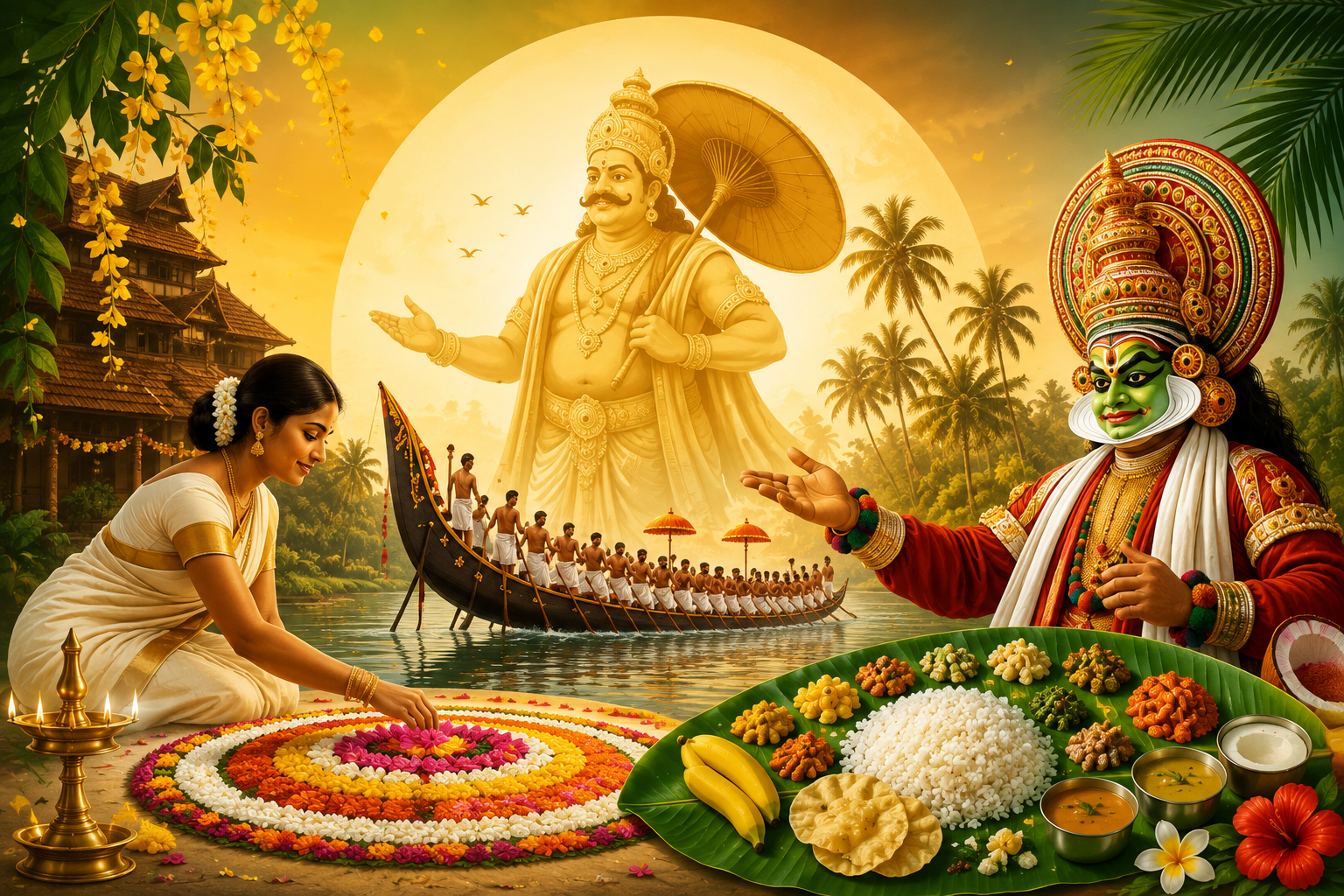
Thiruvananthapuram, August 26, 2026: Onam 2026 is being celebrated across Kerala, with Thiruvonam falling on Wednesday, August 26. The festival is traditionally observed over 10 days, beginning with Atham in the Malayalam month of Chingam and reaching its main celebration on Thiruvonam. Kerala Tourism describes Onam as both a harvest festival and a celebration associated with the traditional story of King Mahabali.
The festival is marked by floral decorations, traditional food, cultural performances, community celebrations and boat races. In 2026, the Kerala Tourism Department has also scheduled its Onam Tourism Week from August 24 to 30.
Onam 2026 Date: When Is Thiruvonam?
The principal day of Onam 2026 is Wednesday, August 26. Kerala Tourism’s official 2026 festival calendar lists Thiruvonam on August 26 across Kerala.
Onam traditionally extends across 10 days, beginning with Atham and culminating in Thiruvonam, the most important day of the festival.
Onam 2026 Important Dates
| Festival Day | Date |
|---|---|
| Atham | August 16, 2026 |
| Uthradam | August 25, 2026 |
| Thiruvonam | August 26, 2026 |
| Third Onam | August 27, 2026 |
| Fourth Onam | August 28, 2026 |
| Onam Tourism Week | August 24–30, 2026 |
The tourism calendar notes that festival dates can vary according to local customs and traditions, so specific religious observances may differ by location.
What Is Onam?
Onam is one of Kerala’s major traditional festivals. It combines agricultural, cultural and religious traditions and is particularly associated with the story of King Mahabali, whose annual return is celebrated during the festival.
Kerala Tourism describes Onam as a harvest festival connected with the agricultural cycle and the arrival of the Malayalam month of Chingam.
The festival has also developed into a major public celebration featuring Kerala’s food, performing arts, games, floral designs and boat-racing traditions.
Onam History and the Legend of King Mahabali
The best-known Onam tradition centres on Mahabali, a legendary king remembered in Kerala’s cultural tradition for his prosperous and just rule.
According to the traditional story, Lord Vishnu appeared before Mahabali in the form of Vamana and asked for three paces of land. Vamana then expanded in size and covered the earth and heavens in two steps. Mahabali offered his own head for the remaining step. The legend says that Vishnu subsequently granted Mahabali permission to visit his people once every year. This annual return is traditionally associated with Onam.
This account is a religious and cultural legend, not a claim about a historically documented king.
Why Is Onam Celebrated?
Onam has two major cultural associations: the Mahabali tradition and Kerala’s harvest season.
The festival falls in the Malayalam month of Chingam, which marks an important period in Kerala’s traditional agricultural calendar. The harvest association is reflected in the festival’s emphasis on abundance, food and community gatherings.
The Mahabali story, meanwhile, gives the festival its distinctive mythological identity.
Pookkalam: The Floral Tradition of Onam
One of the most recognisable symbols of Onam is the Pookkalam, a decorative floral arrangement created on the ground.
Pookkalams are traditionally made outside homes and other public spaces during the 10-day festival. They are associated with welcoming Mahabali and are often created collectively by families, neighbourhoods, schools and organisations.
The floral designs become an important part of the festive atmosphere as Thiruvonam approaches.
Onam Sadya: The Traditional Feast
Onasadya, or the traditional Onam feast, is another central part of the celebration.
It is a vegetarian meal generally served on a banana leaf. The menu can contain numerous preparations, with dishes such as avial, sambar and payasam commonly associated with the feast.
The exact dishes and preparation styles can vary between households and regions.
Vallamkali: Kerala’s Snake Boat Races
Vallamkali, commonly known as the snake boat race, is closely associated with Kerala’s festive season.
The races feature long traditional boats rowed by teams in coordinated movements, often accompanied by rhythmic songs and chants. Boat races form an important part of the cultural events associated with Onam.
Kerala Tourism’s 2026 calendar lists the Aranmula Boat Race on August 30, 2026, during the wider Onam period.
Cultural Performances During Onam
Onam celebrations also provide a platform for Kerala’s traditional performing arts.
Major forms associated with the festival include:
- Kathakali
- Thiruvathirakali
- Pulikali
- Traditional music and dance
- Folk performances
- Community games
Pulikali, particularly associated with Thrissur, features performers dressed and painted to resemble tigers and dancing to traditional music.
Athachamayam and the Beginning of Festive Celebrations
Athachamayam, held at Thripunithura in Ernakulam district, is an important cultural event associated with the beginning of Onam festivities.
Kerala Tourism records that the procession has historical links with the former royal traditions of the Cochin state and was revived in 1961 when Onam developed into a mass public festival.
Today, the event features folk art forms, musicians and cultural performances.
Onam Declared Kerala’s National Festival
Onam received formal recognition as the national festival of Kerala in 1961 under the state government headed by then Chief Minister Pattom Thanu Pillai, according to Kerala Tourism.
The following year, the planned public celebrations were affected by the India-China War, after which Onam continued to develop as a large-scale public festival in Kerala.
Onam Tourism Week 2026
The Kerala Tourism Department has announced its Onam Tourism Week Celebrations from August 24 to August 30, 2026.
According to the department’s July 2026 announcement, the programme will feature classical, folk, ethnic and popular art forms at multiple venues. The celebrations are scheduled to conclude with a procession on August 30.
The programme is intended to showcase Kerala’s cultural traditions to visitors, including international tourists.
What Makes Onam Important to Kerala?
Onam brings together several aspects of Kerala’s cultural identity: traditional food, floral art, performing arts, agricultural traditions, community celebrations and folklore.
Although the Mahabali story is the most widely recognised legend associated with the festival, Kerala Tourism also notes that other traditions and narratives concerning the origin of Onam exist.
Onam 2026: Key Facts
| Particular | Details |
|---|---|
| Festival | Onam |
| Main day | Thiruvonam |
| Thiruvonam 2026 | August 26, 2026 |
| Traditional duration | 10 days |
| Beginning | Atham |
| Malayalam month | Chingam |
| State associated with the festival | Kerala |
| Legendary figure | King Mahabali |
| Vamana connection | Traditional Vishnu legend |
| Floral decoration | Pookkalam |
| Traditional feast | Onasadya |
| Boat-racing tradition | Vallamkali |
| Popular art forms | Kathakali, Thiruvathirakali, Pulikali |
| Onam Tourism Week 2026 | August 24–30 |
| Aranmula Boat Race 2026 | August 30 |
| Kerala’s national festival status | Declared in 1961 |
Happy Onam 2026
Happy Onam 2026! Thiruvonam on August 26 marks the principal day of this year’s traditional Onam celebrations. Across Kerala, the festival is being observed through Pookkalam, Onasadya, cultural programmes, traditional performances and community events.
The 2026 celebrations also extend into Kerala Tourism’s official Onam Tourism Week, scheduled from August 24 to 30.