
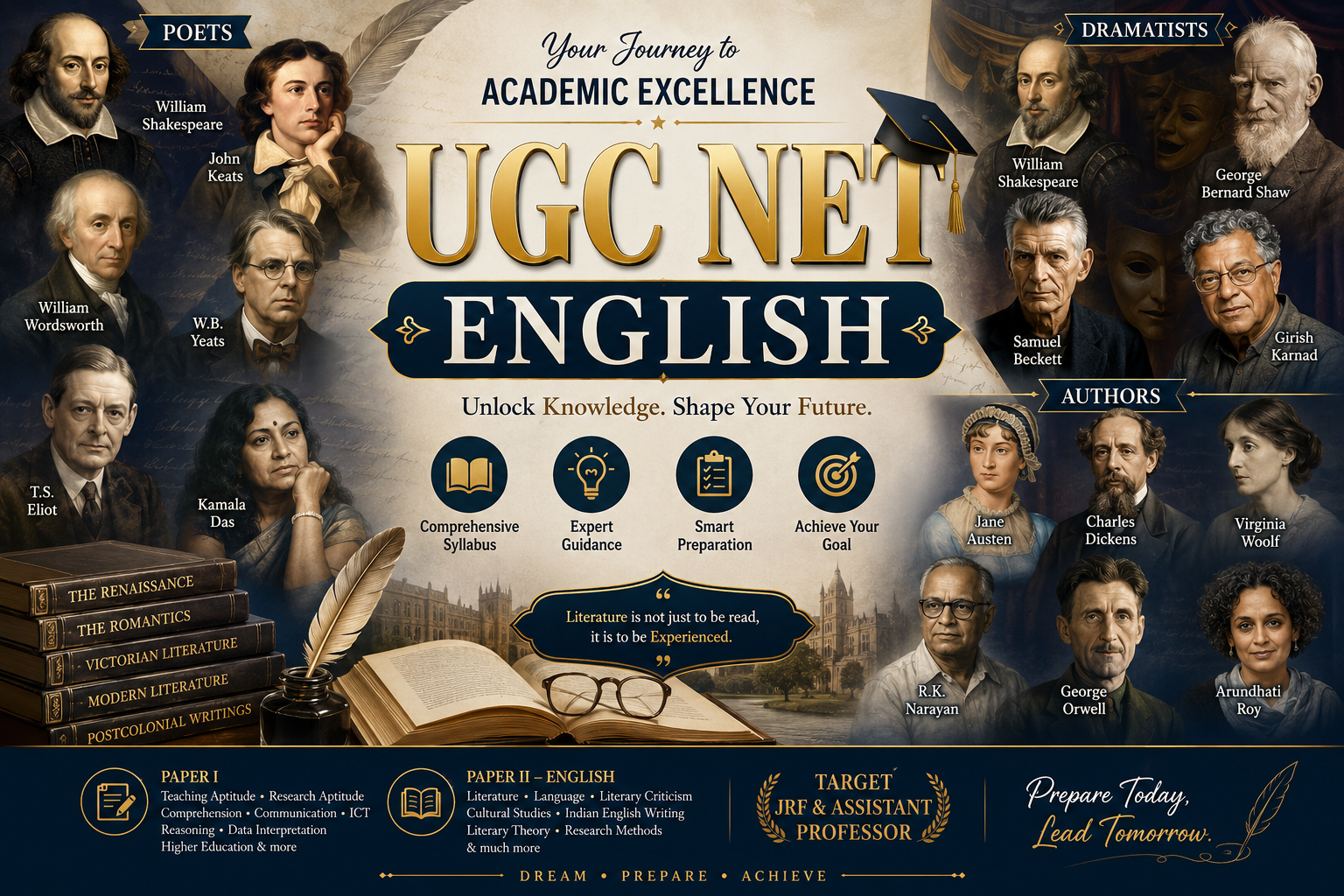
The UGC NET Syllabus 2026 is an essential resource for candidates preparing for the University Grants Commission National Eligibility Test (UGC NET). The examination is conducted by the National Testing Agency (NTA) to determine eligibility for Assistant Professor and Junior Research Fellowship (JRF), subject to the applicable rules and eligibility conditions.
UGC NET consists of two papers: Paper 1 and Paper 2. Paper 1 is common to all candidates and tests teaching and research aptitude, reasoning, communication, ICT, data interpretation and related areas. Paper 2 is based on the subject selected by the candidate.
For candidates preparing for UGC NET English, Paper 2 covers major areas of English literature, language, literary criticism, theory, cultural studies, Indian writing in English and research methodology.
UGC NET Exam Pattern 2026
The UGC NET examination consists of 150 compulsory questions carrying a total of 300 marks.
| Paper | Subject | Questions | Marks |
|---|---|---|---|
| Paper 1 | General/Teaching & Research Aptitude | 50 | 100 |
| Paper 2 | Subject-specific paper | 100 | 200 |
| Total | — | 150 | 300 |
The examination is conducted in Computer Based Test (CBT) mode. Candidates get 3 hours to attempt both papers, with no separate break between Paper 1 and Paper 2.
Each correct answer carries 2 marks. There is no negative marking for incorrect answers.
UGC NET Paper 1 Syllabus
Paper 1 is common to candidates from all subjects. It contains 10 major units.
Unit 1: Teaching Aptitude
This unit focuses on the basic concepts and principles of teaching and learning.
Important topics include:
- Teaching: concept, objectives and characteristics
- Levels of teaching
- Learner characteristics
- Factors affecting teaching
- Methods of teaching
- Teaching support systems
- Evaluation systems
- Online and technology-enabled teaching
Unit 2: Research Aptitude
Research Aptitude is an important component of Paper 1.
Topics include:
- Meaning and characteristics of research
- Types and methods of research
- Research process
- Research design
- Thesis and article writing
- Referencing and citation
- Application of ICT in research
- Research ethics
- Plagiarism
Unit 3: Comprehension
Candidates are provided with a passage followed by questions testing their ability to understand and interpret the given text.
Important skills include:
- Understanding the central idea
- Identifying facts and inferences
- Interpretation
- Logical understanding
- Vocabulary in context
Unit 4: Communication
This unit deals with the principles and processes of communication.
Important areas include:
- Meaning and types of communication
- Effective communication
- Verbal and non-verbal communication
- Barriers to communication
- Classroom communication
- Mass media and society
Unit 5: Mathematical Reasoning and Aptitude
Major topics include:
- Number series
- Letter series
- Coding-decoding
- Mathematical operations
- Ratio and proportion
- Percentage
- Profit and loss
- Time and distance
- Basic mathematical reasoning
Unit 6: Logical Reasoning
Important topics include:
- Arguments
- Deductive and inductive reasoning
- Categorical propositions
- Analogies
- Venn diagrams
- Logical fallacies
- Indian logic
- Pramanas and inference
Unit 7: Data Interpretation
Candidates should prepare:
- Sources and acquisition of data
- Classification of data
- Quantitative and qualitative data
- Tables
- Bar graphs
- Pie charts
- Histograms
- Line graphs
- Data interpretation and analysis
Unit 8: Information and Communication Technology
ICT is a recurring area in Paper 1.
Topics include:
- Computer basics
- Internet
- Intranet
- Digital initiatives
- Online learning
- ICT applications in higher education
- MOOCs
- SWAYAM and other digital learning initiatives
Unit 9: People, Development and Environment
Important areas include:
- Sustainable development
- Human-environment interaction
- Natural resources
- Pollution
- Climate change
- Environmental issues
- Environmental legislation
- Disaster management
- Environmental protection
Unit 10: Higher Education System
Candidates should cover:
- Development of higher education in India
- Institutions of higher learning
- Governance and administration
- Accreditation
- Professional and technical education
- Higher education policies
- Regulatory and quality-related initiatives
UGC NET English Syllabus 2026: Paper 2
Candidates appearing for UGC NET English should prepare Paper 2 systematically across the 10 prescribed units.
Unit 1: Drama
This unit covers the development of English drama across different literary periods.
Important areas include:
- Classical drama
- Medieval drama
- Renaissance drama
- Elizabethan and Jacobean drama
- Restoration drama
- Eighteenth-century drama
- Romantic and Victorian drama
- Modern drama
- Contemporary drama
- Indian English drama
Important dramatists include:
- Christopher Marlowe
- William Shakespeare
- Ben Jonson
- John Webster
- William Congreve
- Richard Sheridan
- Oscar Wilde
- George Bernard Shaw
- Samuel Beckett
- Harold Pinter
- Tom Stoppard
- Girish Karnad
- Mahesh Dattani
Unit 2: Poetry
The Poetry unit covers major developments in English poetry from the early period to contemporary literature.
Candidates should study:
- Old English poetry
- Middle English poetry
- Renaissance poetry
- Metaphysical poetry
- Neoclassical poetry
- Romantic poetry
- Victorian poetry
- Modern poetry
- Contemporary poetry
- Indian English poetry
Important poets include:
- Geoffrey Chaucer
- Edmund Spenser
- William Shakespeare
- John Donne
- John Milton
- Alexander Pope
- William Blake
- William Wordsworth
- S.T. Coleridge
- P.B. Shelley
- John Keats
- Alfred Tennyson
- Robert Browning
- Matthew Arnold
- W.B. Yeats
- T.S. Eliot
- W.H. Auden
- Ted Hughes
- Seamus Heaney
Unit 3: Fiction and Short Story
This unit focuses on the development of fiction and short-story traditions.
Important areas include:
- Rise of the English novel
- Eighteenth-century fiction
- Victorian fiction
- Modernist fiction
- Postmodern fiction
- Contemporary fiction
- Indian English fiction
- Commonwealth fiction
- Short stories
Important writers include:
- Daniel Defoe
- Samuel Richardson
- Henry Fielding
- Laurence Sterne
- Jane Austen
- Charles Dickens
- George Eliot
- Thomas Hardy
- Joseph Conrad
- James Joyce
- Virginia Woolf
- D.H. Lawrence
- E.M. Forster
- George Orwell
- William Golding
- Salman Rushdie
- Amitav Ghosh
- Arundhati Roy
Unit 4: Non-Fictional Prose
Candidates should study important forms and writers of English prose.
Major areas include:
- Essays
- Biography
- Autobiography
- Letters
- Diaries
- Travel writing
- Literary prose
- Political and philosophical writing
Important writers include:
- Francis Bacon
- John Dryden
- Joseph Addison
- Richard Steele
- Jonathan Swift
- Samuel Johnson
- Charles Lamb
- William Hazlitt
- Thomas De Quincey
- Thomas Carlyle
- John Ruskin
- Matthew Arnold
- George Orwell
Unit 5: Language
Language is a concept-heavy component of UGC NET English.
Important topics include:
- Origin of language
- Language families
- Language change
- Historical linguistics
- Phonetics
- Phonology
- Morphology
- Syntax
- Semantics
- Pragmatics
- Sociolinguistics
- Psycholinguistics
- Stylistics
- English Language Teaching
Candidates should be particularly familiar with concepts such as:
- Langue and parole
- Signifier and signified
- Competence and performance
- Synchronic and diachronic approaches
- Phoneme and morpheme
- Dialect and register
Unit 6: English in India
This unit examines the development and use of English in the Indian context.
Important topics include:
- History of English in India
- English education in India
- Indian English
- Colonial context
- Indian English literature
- Indian English poetry
- Indian English fiction
- Indian English drama
- Indian literary criticism
Important writers include:
- R.K. Narayan
- Mulk Raj Anand
- Raja Rao
- Anita Desai
- Kamala Das
- Nissim Ezekiel
- A.K. Ramanujan
- Jayanta Mahapatra
- Salman Rushdie
- Vikram Seth
- Amitav Ghosh
- Arundhati Roy
Unit 7: Cultural Studies
Cultural Studies connects literature with society, politics, media and ideology.
Important areas include:
- Culture and society
- Popular culture
- Mass culture
- Representation
- Ideology
- Power
- Gender
- Race
- Class
- Colonialism
- Postcolonialism
- Media studies
- Subaltern studies
Important thinkers include:
- Raymond Williams
- Stuart Hall
- Antonio Gramsci
- Michel Foucault
- Louis Althusser
- Edward Said
- Homi K. Bhabha
- Gayatri Chakravorty Spivak
Unit 8: Literary Criticism
Literary Criticism is one of the core areas of UGC NET English preparation.
Classical Criticism
- Plato
- Aristotle
- Horace
- Longinus
Renaissance Criticism
- Philip Sidney
- Ben Jonson
Neoclassical Criticism
- John Dryden
- Alexander Pope
- Samuel Johnson
Romantic Criticism
- William Wordsworth
- S.T. Coleridge
- P.B. Shelley
Victorian Criticism
- Matthew Arnold
- Walter Pater
Modern Criticism
- T.S. Eliot
- I.A. Richards
- F.R. Leavis
- Cleanth Brooks
- Northrop Frye
Candidates should learn not only the names of critics but also their major works, concepts and critical arguments.
Unit 9: Literary Theory After World War II
This unit covers major twentieth-century and contemporary theoretical approaches.
Structuralism
Important thinkers:
- Ferdinand de Saussure
- Claude Lévi-Strauss
- Roland Barthes
Poststructuralism
- Jacques Derrida
- Michel Foucault
- Roland Barthes
Marxist Theory
- Karl Marx
- Antonio Gramsci
- Louis Althusser
- Terry Eagleton
Feminist Theory
- Simone de Beauvoir
- Elaine Showalter
- Kate Millett
- Judith Butler
- Hélène Cixous
Psychoanalytic Theory
- Sigmund Freud
- Carl Jung
- Jacques Lacan
Reader-Response Theory
- Wolfgang Iser
- Hans Robert Jauss
- Stanley Fish
Postcolonial Theory
- Edward Said
- Homi K. Bhabha
- Gayatri Chakravorty Spivak
New Historicism
- Stephen Greenblatt
Ecocriticism
Candidates should understand the development and major concepts of ecocritical approaches.
Unit 10: Research Methods and Materials in English
The final unit focuses on literary research and academic methodology.
Important topics include:
- Research methodology
- Research design
- Primary and secondary sources
- Bibliography
- Citation
- Plagiarism
- Academic writing
- Literary databases
- Digital humanities
- Research ethics
- MLA style
- Digital research resources
How to Prepare UGC NET English Syllabus
Completing the syllabus is only the first step. Candidates should combine literary history with intensive practice.
1. Prepare Literature Chronologically
Start with:
Old English → Middle English → Renaissance → Neoclassical → Romantic → Victorian → Modern → Postmodern/Contemporary
This makes it easier to understand literary movements and relationships between writers.
2. Create Author–Work Lists
For every important writer, remember:
Author → Major Works → Genre → Period → Movement → Important Characters/Concepts
3. Give Special Attention to Criticism and Theory
Do not simply memorize theorists. Learn:
Theorist → Major Work → Theory → Key Concept → Example
4. Solve Previous-Year Questions
PYQs are extremely important because they reveal recurring authors, works, concepts and question patterns.
A useful revision cycle is:
Study → PYQs → Analyse mistakes → Revise → Practice MCQs
5. Do Not Ignore Paper 1
Paper 1 can significantly improve the overall score. Candidates should regularly practise:
- Teaching Aptitude
- Research Aptitude
- Reasoning
- ICT
- Communication
- Data Interpretation
- Higher Education
UGC NET English Preparation Priority
For candidates looking for an efficient preparation sequence, the following order can be useful:
| Priority | Area |
|---|---|
| Very High | Literary Criticism |
| Very High | Literary Theory |
| Very High | Poetry |
| Very High | Drama |
| High | Fiction |
| High | English in India |
| High | Language |
| High | Research Methods |
| Moderate-High | Cultural Studies |
| Moderate | Non-Fictional Prose |
This does not mean that candidates should skip any prescribed unit. The complete syllabus should be covered before the examination.
UGC NET Preparation Strategy
A practical strategy is to divide preparation into four stages:
Stage 1: Syllabus Coverage
Complete all prescribed units and identify strong and weak areas.
Stage 2: Concept Building
Prepare literary periods, movements, authors, works, critics and theories.
Stage 3: PYQ Practice
Solve previous-year questions topic-wise and maintain an error notebook.
Stage 4: Revision and Mock Tests
Take full-length Paper 1 and Paper 2 tests and revise repeatedly.
Quick Revision Formula
For English Literature, remember:
Period → Movement → Author → Work → Genre → Theme → Critic/Theorist → Concept
This approach is particularly useful for UGC NET because questions can connect an author, work, movement, theory and literary period.
Frequently Asked Questions About UGC NET Syllabus 2026
Is UGC NET Paper 1 compulsory?
Yes. Candidates appearing for UGC NET take both Paper 1 and the subject-specific Paper 2.
How many questions are asked in UGC NET English?
Paper 2 contains 100 questions carrying 200 marks.
Is there negative marking in UGC NET?
There is no negative marking for incorrect answers.
How many marks are there in UGC NET?
The examination carries 300 marks in total: 100 marks for Paper 1 and 200 marks for Paper 2.
What is the subject code for UGC NET English?
English is Subject Code 30.
How many units are there in UGC NET English?
The English syllabus is organised into 10 units, covering drama, poetry, fiction and short stories, non-fictional prose, language, English in India, cultural studies, literary criticism, literary theory and research methods.
The UGC NET Syllabus 2026 should be treated as the foundation of preparation rather than simply a checklist. For English candidates, strong command over literary history, authors and works, criticism, literary theory, language, Indian English literature and research methodology is essential.
Candidates should also combine syllabus coverage with PYQs, revision notes and regular mock tests. A structured approach can make the extensive English syllabus considerably easier to manage.
Official source: Candidates should always verify the applicable examination notification and detailed syllabus through the official NTA UGC-NET portal before making final preparation decisions.