
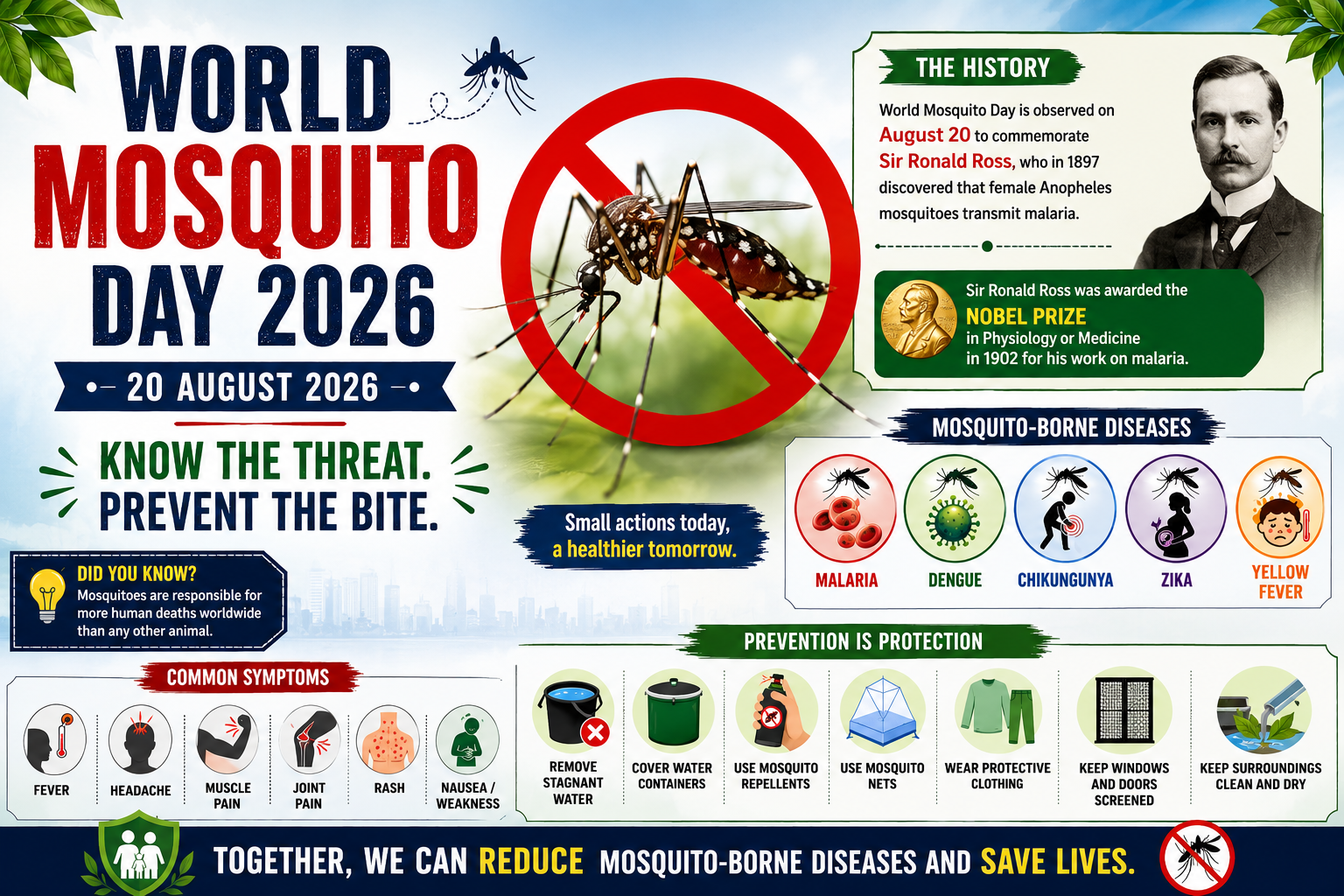
New Delhi, August 20, 2026: World Mosquito Day 2026 is being observed on August 20 to highlight the role of mosquitoes in the transmission of malaria and other infectious diseases. The annual observance commemorates the work of British physician and researcher Sir Ronald Ross, who demonstrated the role of female Anopheles mosquitoes in malaria transmission in 1897.
World Mosquito Day 2026: History
World Mosquito Day is observed every year on August 20 in recognition of Ronald Ross’s landmark malaria research.
Ross was working in the Indian Medical Service when he established evidence linking Anopheles mosquitoes with the transmission of malaria. The discovery was made on August 20, 1897, and became an important milestone in the scientific understanding of malaria transmission.
Ross was awarded the Nobel Prize in Physiology or Medicine in 1902 for his work on malaria.
Why Is World Mosquito Day Observed?
The day draws attention to mosquitoes as vectors of infectious diseases and highlights the importance of research, disease surveillance, mosquito control and preventive measures.
Mosquito-borne diseases include malaria, dengue, chikungunya, Zika and yellow fever, among others. Different mosquito species are responsible for transmitting different diseases.
Major Diseases Spread by Mosquitoes
Malaria
Malaria is caused by Plasmodium parasites and is transmitted to humans through the bite of infected female Anopheles mosquitoes.
Fever, chills and sweating are common symptoms associated with malaria. Severe malaria can lead to serious complications and requires timely medical treatment.
Dengue
Dengue is a viral infection transmitted primarily by infected Aedes mosquitoes. Symptoms can include fever, headache, muscle and joint pain and rash.
Chikungunya
Chikungunya is a mosquito-borne viral disease. Fever and severe joint pain are among its characteristic symptoms.
Zika
Zika virus is primarily transmitted by infected Aedes mosquitoes. Infection is often mild, but Zika infection during pregnancy can have serious consequences for the developing fetus.
Yellow Fever
Yellow fever is a viral disease transmitted by infected mosquitoes. It can range from a mild illness to a severe disease involving complications such as jaundice and organ dysfunction.
World Mosquito Day 2026: Common Symptoms
Symptoms depend on the particular mosquito-borne infection. Some commonly reported symptoms include:
- Fever
- Headache
- Chills
- Muscle or body pain
- Joint pain
- Weakness or fatigue
- Skin rash
- Nausea
These symptoms can occur in several infections and cannot by themselves determine which disease a person has.
How to Prevent Mosquito-Borne Diseases
Reducing mosquito exposure and eliminating breeding sites are important components of mosquito control.
Preventive measures include:
- Remove standing water from containers around homes and workplaces.
- Keep water-storage containers covered.
- Clean areas where rainwater can collect.
- Use mosquito nets where appropriate.
- Use suitable mosquito repellents according to product instructions.
- Wear clothing that reduces exposed skin when mosquito activity is high.
- Use window and door screens where available.
- Follow public-health instructions during local mosquito-borne disease outbreaks.
World Mosquito Day 2026: Importance
More than a century after Ronald Ross’s discovery, mosquito-borne diseases continue to be an important public-health concern. The London School of Hygiene & Tropical Medicine notes that diseases such as malaria, dengue, Zika and chikungunya continue to affect populations around the world.
World Mosquito Day therefore serves both as a reminder of the historical breakthrough in malaria research and as an opportunity to highlight continuing efforts in mosquito surveillance, disease prevention and vector control.
World Mosquito Day 2026: Key Facts
| Particular | Details |
|---|---|
| Day | World Mosquito Day |
| Date | August 20 |
| 2026 observance | August 20, 2026 |
| Scientist associated with the day | Sir Ronald Ross |
| Landmark year | 1897 |
| Key discovery | Mosquito transmission of malaria |
| Mosquito associated with malaria transmission | Female Anopheles |
| Nobel Prize | Physiology or Medicine, 1902 |
| Major mosquito-borne diseases | Malaria, dengue, chikungunya, Zika, yellow fever |
World Mosquito Day 2026
World Mosquito Day is observed on August 20 to commemorate Ronald Ross’s work on malaria transmission and to raise awareness about mosquito-borne diseases. The day continues to connect the history of medical research with the ongoing importance of prevention, mosquito control and public-health measures.